Article: Best headgear muay thai for every training level
Best headgear muay thai for every training level
Key Takeaways
- headgear muay thai provides a critical safety barrier during sparring, absorbing high-velocity impacts and preventing the cuts or abrasions that often occur during clinch work.
- Optimal protection requires a design that offers a wide field of vision, allowing you to see low kicks and knees coming from angles that traditional boxing headgear might block.
- Choose gear with high-density foam and secure, adjustable fastening systems to ensure the unit stays in place and does not rotate when you take a strike.
- Premium headgear incorporates moisture-wicking interior linings to manage sweat, which keeps the equipment from sliding and prevents stinging in the eyes during long rounds.
Headgear Muay Thai provides a critical safety barrier by absorbing high-velocity impacts and preventing facial lacerations during technical sparring. A wide peripheral field of vision is essential so you can track low kicks and knees that standard boxing gear often obscures. This visibility is critical for protecting high-risk zones like the temples and jawline.
Quality headgear bridges the gap between professional protection and training comfort. Multi-layer high-density foam ensures the unit remains stationary during heavy exchanges. Integrated moisture-wicking linings prevent sweat from stinging your eyes or causing the padding to slide during intensive clinch work.
Table of Contents
- What is muay thai headgear ?
- Types of muay thai headgear you should consider
- How to pick the right muay thai headgear for your head shape
- How different headgear types compare for Muay Thai training
- Safety tips for using headgear during sparring and competition
- Complete your Muay Thai protection setup with MAVINN
- Easy ways to keep your headgear clean and odor free
- Conclusion
What is muay thai headgear ?

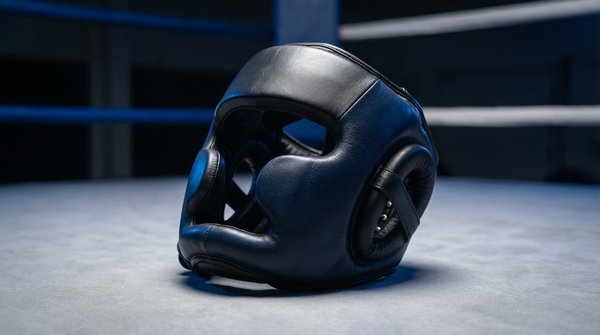
Headgear muay thai is a specialized protective shell designed to absorb high-velocity impacts and prevent lacerations during intense full-contact sparring sessions. It differs from standard boxing equipment by offering reinforced padding around the ears and temples specifically to handle the unique angles of elbows and high kicks. Professional models employ high-density injected molded foam to maintain structural integrity under repeated heavy impacts.
A proper fit ensures the guard remains stationary during rapid head movement, which is critical when transitioning from striking into a tight clinch. You need a wide field of vision because seeing a roundhouse kick coming from your peripheral is your primary line of defense. Top-tier gear often uses premium cowhide leather to resist moisture and maintain padding density over years of consistent daily training.
Real benefits of using head protection during training

Headgear Muay Thai significantly reduces the risk of acute facial trauma and superficial lacerations that occur during high-intensity clinch work and sparring. While it cannot eliminate concussions, the high-density foam absorbs substantial kinetic energy from roundhouse kicks and elbows. This protection ensures you stay in the gym rather than recovering from preventable stitches or orbital bruising.
- Mitigates skin friction: The outer shell prevents the tearing of facial tissue near the brows and cheekbones.
- Ear protection: Reinforced padding guards against cauliflower ear and ruptured eardrums from heavy hooks.
- Vision for defense: Wide-angle designs allow you to track low kicks that land outside the vision range of standard gear.
- Energy displacement: Triple-layer padding spreads strike force across a wider surface area to reduce localized impact.
Quality headgear stays locked in place even when you take a direct shot or enter a tight clinch. This stability prevents the padding from shifting and blocking your sight mid-exchange. Professional fighters prioritize a snug fit with quality padding to maintain their training volume throughout an extended fight camp.
Types of muay thai headgear you should consider

You should select between open-face, cheek-protector, or face-bar models based on your sparring intensity and defensive needs. Open-face designs offer the widest field of vision, making them the standard for amateur sanctioned bouts. Cheek-protectors are the industry standard for heavy sparring, providing reinforced orbital bone coverage. Face-bar models utilize a reinforced internal frame to eliminate direct contact with the nose, which is critical for professionals managing existing facial injuries.
| Headgear Type | Primary Benefit | Best For | Weight |
|---|---|---|---|
| Open-Face | Maximum visibility | Amateur competition | 8–10 oz |
| Cheek-Protector | Orbital bone safety | Daily heavy sparring | 10–12 oz |
| Face-Bar | Nose protection | Injury prevention | 14–16 oz |
Cheek-protectors in the 10–12 oz range help prevent neck fatigue during high-intensity clinch sessions without sacrificing protection. Face-bar gear ensures you stay in the gym by preventing superficial lacerations or orbital bruising that could stall your training progress.
Open face headgear for maximum visibility
Open-face headgear muay thai provides the widest field of vision possible, allowing you to see incoming kicks and knees that often disappear in your peripheral blind spots. These guards protect the forehead, temples, and ears while leaving the jaw and nose exposed for better airflow and communication. This design is the standard choice for technical sparring where tracking your opponent's hip movement is more critical than heavy impact protection.
- 180-degree peripheral vision to track high kicks and hooks.
- Reduced weight to prevent neck fatigue during long clinching sessions.
- Maximum ventilation to keep your head cool during high-intensity rounds.
While you sacrifice some facial coverage, the tactical advantage of seeing every strike coming helps you develop better defensive timing. You will notice a significant difference in heat management because the open design prevents sweat from pooling around your eyes during training. Most professional gyms recommend open-face gear for students focusing on speed and counter-striking drills.
Full face protection with cheek guards
Full face protection with cheek guards provides a critical safety barrier for your nose and orbital bones without sacrificing your peripheral vision. This style of headgear muay thai is the industry standard for high-intensity sparring because it absorbs direct impact across the mid-face region. These guards are designed to sit high enough to shield the bridge of the nose while remaining slim enough to see incoming strikes from low angles.
Advanced cheek guards often feature triple-layered foam to prevent the facial bones from absorbing the full force of a heavy hook or cross. This coverage is essential for fighters who need to avoid visible bruising or "black eyes" during their training camp. Professional gyms typically mandate this specific design during hard sessions to minimize the risk of nasal fractures and soft tissue lacerations.
Face bar headgear for intensive sparring
Face bar headgear provides the ultimate shield for your nose and eyes during high-intensity sessions by placing a reinforced barrier across the mid-face. You should choose this design if you are recovering from a nasal injury or need to show up to work without a single mark on your face. This setup provides maximum frontal protection, preventing the leather from making contact with your skin during heavy exchanges.
The trade-off for this maximum protection is a narrower field of vision, particularly when defending against low kicks or knees. Well-engineered slim-profile bars address this by maximizing your peripheral sight without compromising the structural integrity of the frame. Ensure your headgear muay thai features a lace-up top and a heavy-duty chin strap to keep the bar perfectly aligned with your brow line during high-volume exchanges.
How to pick the right muay thai headgear for your head shape

The right Muay Thai headgear should wrap your skull without shifting during impact or obstructing your peripheral vision. If you have a narrower face, look for "cheek protector" models that fill the gap between your cheekbones and the padding to prevent lateral movement. Broader head shapes usually benefit from adjustable lace-top closures rather than fixed elastic to allow for 1-2 inches of expansion.
Follow these steps to ensure the gear matches your specific anatomy:
- Measure your head circumference one inch above your eyebrows using a soft tape.
- Test the chin strap to ensure it doesn't pinch your throat or restrict breathing during high-intensity rounds.
- Check that the eye openings allow for clear sightlines to track incoming low kicks and knees.
Avoid gear that feels tight on the temples but loose at the back, as this indicates the internal mold is too narrow for your skull. Most pro-grade headgear muay thai options use high-density foam that breaks in and molds to your bone structure after roughly five to ten sparring sessions. Ensure the ear padding has built-in air channels to prevent painful eardrum suction during heavy impact.
How different headgear types compare for Muay Thai training
Not all headgear is built for Muay Thai. Point-sparring gear — common in Karate and Taekwondo — typically uses lightweight single-mold foam that prioritizes speed and ventilation over impact absorption. Professional Muay Thai headgear instead uses dense, multi-layered padding and reinforced cheek and chin guards to withstand elbows, knees, and hook combinations during full-contact clinching.
Premium materials like leather or high-tensile microfiber are standard in purpose-built Muay Thai gear because they resist acidic sweat and maintain structural integrity far longer than entry-level vinyl construction. Multi-point closure systems — whether lace-top or adjustable rear buckle — keep the gear stable on your head in a way that basic sparring helmets simply cannot match.
| Feature | Point-Sparring Headgear | Professional Muay Thai Headgear |
|---|---|---|
| Primary Material | Lightweight foam or vinyl | Leather or high-grade microfiber |
| Padding Style | Single-mold foam | Multi-layered shock-absorbing foam |
| Face Protection | Open-face or basic coverage | Thick cheek and chin protectors |
| Main Use Case | Light contact, point sparring | Full-contact Muay Thai and Boxing |
| Weight Profile | Ultra-lightweight for speed | Heavier, focused on maximum safety |
Safety tips for using headgear during sparring and competition

You must achieve a zero-shift fit by tensioning the chin strap and rear lace system to prevent rotation during high-impact exchanges. Loose gear creates dangerous blind spots that leave you vulnerable to unseen follow-up strikes or elbows. A "snug-lock" feel that stabilizes the frame without compressing your jaw or restricting breathing is the standard to aim for.
Maintain hygiene by wiping the interior with a pH-neutral disinfectant to prevent sweat from hardening the shock-absorbing core. Compromised, dried-out foam loses its ability to cushion blows and increases the risk of injury. Replace your headgear muay thai regularly based on how often you train to ensure the padding remains pliable and effective.
Understanding when to replace your old headgear

You must replace your headgear muay thai as soon as the internal padding feels soft or fails to bounce back after a heavy strike. Under consistent sparring conditions, professional-grade foam has a finite lifespan — once the response noticeably softens, the material has reached its limit. If you can feel the impact of a knuckle through the padding without resistance, it is time to upgrade.
Look for these specific signs that your gear is compromised:
- Compressed foam that feels "flat" or thin in high-impact zones.
- Deep cracks in the outer shell or frayed stitching at the chin strap.
- Straps that no longer stay tight, causing the gear to shift.
- A persistent sour odor indicating internal material rot.
Check the density by pressing your thumb firmly into the forehead padding to ensure it resists the pressure. If the headgear slips more than half an inch during a clinch, the structural integrity is gone. Tighten your kit or upgrade to ensure your vision remains clear during high-intensity exchanges.
Complete your Muay Thai protection setup with MAVINN
Headgear is one part of a complete protective system. Serious Muay Thai training demands the best shin pads for Muay Thai, well-fitted boxing gloves, and quality handwraps — gear that absorbs punishment across every session so your body does not have to. MAVINN is a Muay Thai equipment brand built on the principles of Discipline, Precision, and Ambition — the same values that define serious sparring.
For sparring specifically, the MAVINN Boxing Gloves — WORKING PROJECT pairs directly with your headgear setup. Available in 10oz, 12oz, and 14oz across Black and Gray — built to the standard of daily hard training. Browse the full combat gear collection to build out your complete setup.
Easy ways to keep your headgear clean and odor free

Wipe your Muay Thai headgear inside and out with a damp cloth immediately after every session to prevent salt and bacteria from sinking into the padding. Sweat is acidic and will degrade leather or synthetic liners over time if left to soak. Use a mixture of water and a drop of mild dish soap to break down surface oils effectively without damaging the material.
- Use a dry microfiber towel to soak up excess moisture from the inner lining right after training.
- Clean all surfaces with a damp cloth, paying extra attention to high-contact areas like the chin strap and cheek protectors.
- Mist the interior with a specialized gear deodorizer or a 1:1 water and white vinegar solution.
- Open the headgear wide and place it in a cool, well-ventilated area to air dry completely.
Never leave your headgear inside a closed gym bag, as trapped moisture creates a breeding ground for mold and permanent odors. Excessive heat from radiators or direct sunlight will cause cracking and brittleness in the outer shell. Many experienced practitioners use cedar wood sachets or bamboo charcoal bags to pull moisture out of the foam layers overnight.
Conclusion
Selecting the right headgear muay thai is your primary defense against facial lacerations and long-term ear damage during hard sparring sessions. High-quality padding ensures you can trade strikes without frequent interruptions for painful cuts or heavy bruising. Prioritize a balance between visibility and protection, specifically looking for reinforced cheek guards that do not block your low-kick detection.
High-performance gear should feature a genuine leather or microfiber exterior and a non-slip interior to remain stable during clinch-heavy rounds. Ensure your headgear fits tight enough that it only moves when your head moves to prevent the internal liner from irritating your skin. Explore the full range of Muay Thai gloves to complete your sparring setup.