The Ultimate Muay Thai Workout Routine
Key Takeaways
-
A complete Muay Thai workout builds technical skill, explosive strength and cardiovascular endurance in the same session, which is why fighters combine pad work with conditioning rather than choosing either or. Muay Thai training at home is effective for fitness and fundamentals, though timing, defence and clinch work still require a partner and a coach. Choose a training kit that moves with you, starting with a breathable Muay Thai t-shirt from Thailand made for daily gym use.

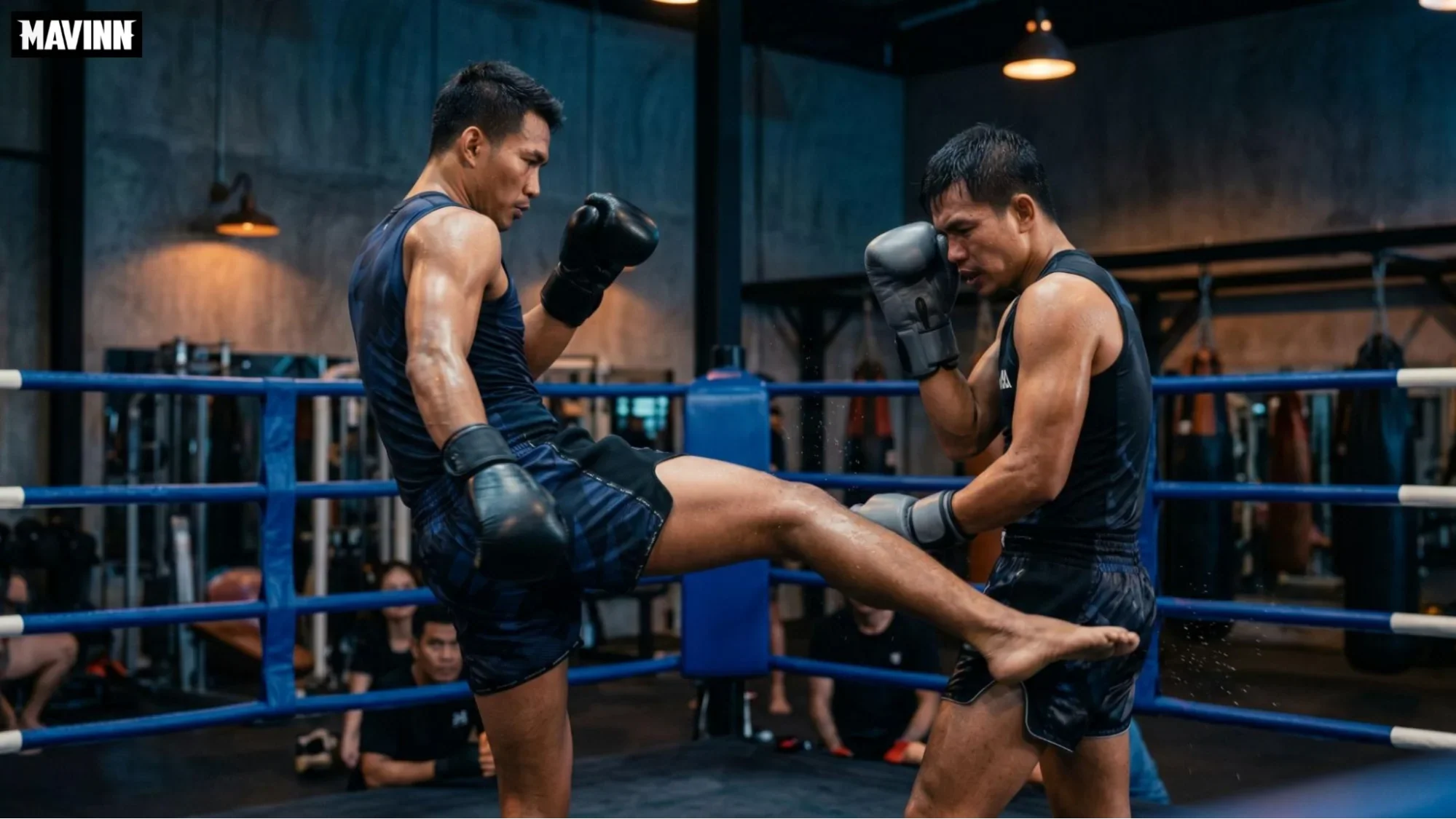
A good Muay Thai workout helps you develop cardiovascular endurance, strength, agility, and coordination, while building the discipline needed to keep going when your round has only three minutes left on the clock.
Training with experienced coaches is still the fastest way to improve technique, but structured home sessions keep your fitness and fundamentals sharp in between gym visits. This guide covers a full muay thai workout routine, beginner-friendly drills you can try at home, and the conditioning that supports better performance in the ring.
Table of Contents
- Key Takeaways
- What Makes A Good Muay Thai Workout
- A Complete Muay Thai Workout Routine
- Muay Thai Training At Home: What Works
- Technique vs. Conditioning: Why You Need Both
- Weekly Training Plan For Beginners
- What To Wear For Muay Thai Training
- Train In MAVINN
- References
- Frequently Asked Questions About Muay Thai Workouts (FAQs)
What Makes A Good Muay Thai Workout
Muay Thai is an intermittent, high-intensity sport. Rounds alternate short explosive exchanges with brief recovery, which places demands on both the aerobic and anaerobic systems at once. A session that only trains one of them leaves a gap.
-
Technical skill: Stance, footwork, punches, kicks, knees and elbows drilled with attention to quality rather than volume.
-
Strength and conditioning: Functional strength, core stability and explosive power, which sports science research supports as a performance benefit rather than a threat to a fighter's flexibility or weight.
-
Cardiovascular endurance: High-intensity intervals that mirror the effort and rest pattern of a real round, so your conditioning matches what the sport actually asks of you.
A Complete Muay Thai Workout Routine
This structure works for a solo session at home or as a supplement to gym classes. Total time runs around 45 to 55 minutes.
Warm-up (5 to 10 minutes)
-
Skipping rope: Three to five minutes to raise heart rate and warm the calves and ankles before any kicking.
-
Dynamic stretching: Leg swings, arm circles and torso rotations rather than static holds.
-
Hip and shoulder mobility: Essential preparation for kicks and full-extension strikes.
-
Light shadowboxing: Two minutes at low intensity to connect the warm-up to technique.
Technical practice (15 to 20 minutes)
-
Shadowboxing rounds: Three rounds of three minutes, focusing on clean mechanics and a relaxed guard.
-
Footwork drills: Forward, backward, lateral and pivoting movement patterns.
-
Combination practice: Two- and three-strike sequences repeated until the transitions feel automatic.
-
Defensive movement: Blocks, checks and slips drilled in isolation before adding them to combinations.
Conditioning (15 to 20 minutes)
-
Push-ups: Build the pressing strength behind punching and clinch frames.
-
Squats and lunges: Develop the leg drive that powers kicks and knees.
-
Burpees: Full-body intervals that spike heart rate quickly.
-
Planks and mountain climbers: Core stability, which controls balance during kicks and knee strikes.
Cool-down
Static stretching for the hips, hamstrings and shoulders, controlled breathing to bring heart rate down, and light mobility work through any area that felt tight during the session.
Muay Thai Training At Home: What Works
Muay Thai training at home is useful for fitness and technique reinforcement, but it has some limitations. Timing, defensive reactions, clinch work and sparring all need a live partner and a coach watching. Treat home sessions as conditioning and repetition work that makes your gym sessions more productive.
Try any of these at-home Muay Thai drills that require almost no equipment:
-
Shadowboxing rounds: Prioritise technique and movement over power. Film a round occasionally and watch it back.
-
Footwork ladder drills: Practise forward and backward steps and lateral movement and pivots.
-
Knee and teep drills: Practise balance, hip drive and controlled return to stance after every strike.
-
Conditioning intervals: Three-minute working rounds with one minute of recovery, mirroring competition pacing.
• Recommended equipment : A jump rope, a heavy bag if you have the space, resistance bands, a round timer and a mirror for reviewing technique.
Common Mistakes During At-Home Muay Thai Training
-
Prioritising power over technique
-
Skipping warm-ups
-
Neglecting footwork
-
Training without recovery
• Never reviewing your technique
Technique vs. Conditioning: Why You Need Both

Fighters rely on both Muay Thai workouts and dedicated conditioning workouts across a training week. Technique tends to slip under fatigue, so conditioning protects the skills you build in technical sessions.:
-
Technique-focused sessions: Skill development, precision and movement quality, usually performed fresh rather than fatigued.
-
Conditioning sessions: Strength, endurance, speed and power, often run at higher intensity with shorter rest. Most beginners should alternate the two across the week rather than combining them in one long session.
Weekly Training Plan For Beginners
| Day | Focus |
|---|---|
| Monday | Technique and shadowboxing |
| Tuesday | Strength and conditioning |
| Wednesday | Footwork and cardio |
| Thursday | Technique and combinations |
| Friday | HIIT conditioning |
| Saturday | Full Muay Thai workout |
| Sunday | Recovery and mobility |
Table: A suggested weekly training plan for beginners.
What To Wear For Muay Thai Training
The training kit is an undeniable part of your programme. Heavy cotton holds sweat, restrictive cuts limit kicking range, and anything that catches in the clinch becomes a distraction. Breathable, loose-fitting t-shirts and shorts let you move through full extension without fabric fighting you.
When considering the best Muay Thai hoodies for training and casual wear, the same principles apply. Look for breathable fabric, room through the shoulders and a weight that suits your climate rather than the look alone.
Train In MAVINN
When you throw an overhand or enter the clinch, restrictive fabrics pull and bind across the shoulders. While apparel will not replace technique, poorly designed gear can become an unnecessary distraction during rounds. MAVINN was founded in 2016 and has spent close to a decade developing professional fighters. That experience shapes everything we make, from ring-ready equipment to streetwear you can wear outside of the ring.
Optimise your training and explore MAVINN's Muay Thai t-shirt Thailand collection, built specifically for intense sessions while still being comfortable enough for everyday wear.
References
- Muay Thai-specific high-intensity interval training enhances anaerobic power in elite fighters. Retrieved July 24, 2026, from https://www.frontiersin.org/journals/sports-and-active-living/articles/10.3389/fspor.2026.1831605/full
- Strength and Conditioning for Muay Thai Athletes. Retrieved July 24, 2026, from https://journals.lww.com/nsca-scj/fulltext/2009/12000/strength_and_conditioning_for_muay_thai_athletes.12.aspx
- Muay Thai exercises improve quality of life, love of life and self-control. Retrieved July 24, 2026, from https://www.ncbi.nlm.nih.gov/pmc/articles/PMC12141284/
Frequently Asked Questions About Muay Thai Workouts (FAQs)
What is the best Muay Thai workout routine?
A balanced session runs a 5 to 10 minute warm-up, 15 to 20 minutes of technical practice, 15 to 20 minutes of conditioning and a proper cool-down. The structure matters more than the individual exercises, since it trains skill and fitness in the same session.
Can I do Muay Thai training at home?
Yes, for fitness, footwork, shadowboxing and conditioning. Timing, defensive reactions, clinch work and sparring need a live partner and a coach, so home training works best alongside gym sessions rather than instead of them.
What are the best Muay Thai drills to do at home?
Shadowboxing rounds, footwork ladder drills, knee and teep balance work, and three-minute conditioning intervals with one minute of recovery. All four need minimal equipment and scale with your fitness.
What is the difference between a Muay Thai workout vs. Muay Thai conditioning workout?
A technique-focused workout develops skill, precision and movement quality while you are fresh. A conditioning workout targets strength, endurance and power at higher intensity. Most fighters run both across the week, because technique breaks down under fatigue.
What equipment do I need for Muay Thai training at home?
A jump rope and a round timer cover the basics. A heavy bag, resistance bands and a mirror add useful options, though stance, footwork and shadowboxing need nothing at all.
What should I wear for a Muay Thai workout?
Breathable, loose-fitting tops that allow full range of motion, paired with shorts cut for kicking. An oversized Muay Thai t-shirt works for training and everyday wear, which is why it is a common choice for daily gym use.

Written by Analytics -