How to Hold Kick Pads Safely in Muay Thai
Key Takeaways
-
Muay Thai pad work is a skill of its own, and a holder's grip, stance and pad angle decide whether it stays safe.
-
Keep the thumb on top or to the side of the pad, never underneath, to protect the joint most exposed to a strike.
-
Hold the pad at roughly 45 degrees and absorb the force through a soft elbow rather than a locked arm.
-
A well-built pad does much of the work, with layered foam and a two-strap forearm system supporting good technique.
-
Explore the full range of Muay Thai kicking pads at MAVINN, built to protect the holder through daily sessions.

Good Muay Thai pad work is teachable rather than instinctive. Grip, stance and pad angle are the three habits that keep a holder safe while letting a fighter throw at full power, and they are worth getting right from the very first session. The majority of new Muay Thai pad holders have an incorrect grip until someone points it out. When a thumb endures the force of a round kick, it frequently causes joint soreness for the following week.
Although holding pads appear passive from the outside, a loose grip, flat pad, or square stance actually puts the holder at risk and creates an unsteady target for the striker.
Table of Contents
How should a pad holder grip the pad?
The grip is the primary source of most holder injuries, making it crucial to fix this before anyone throws a strong kick. A firm hold stabilises the pad and protects the delicate joints of the hand from direct impact.
-
Five-finger grip: wrap all five fingers around the handle with the thumb resting on top or to the side, never tucked underneath the pad.
-
Full-hand contact: spread the hand across the inner surface for control, instead of pinching the pad with the fingertips.
-
Face the striker: keep the striking surface square to the incoming kick so the padding, not the edge, takes the blow.
-
Thumb awareness: a thumb caught under the pad on impact is the most common holder injury, and it rarely gets flagged until it happens.
Secure the grip first to shield the joint most vulnerable to a strong blow. Everything that comes next depends on that base, so repeat it until it feels effortless.
Where should a pad holder stand?
Stance decides whether the force of a kick runs down into the floor or back into the holder's shoulder. A Muay Thai pad holder who stands tall and flat absorbs every strike through the arm alone, which tires fast and increases injury risk.
-
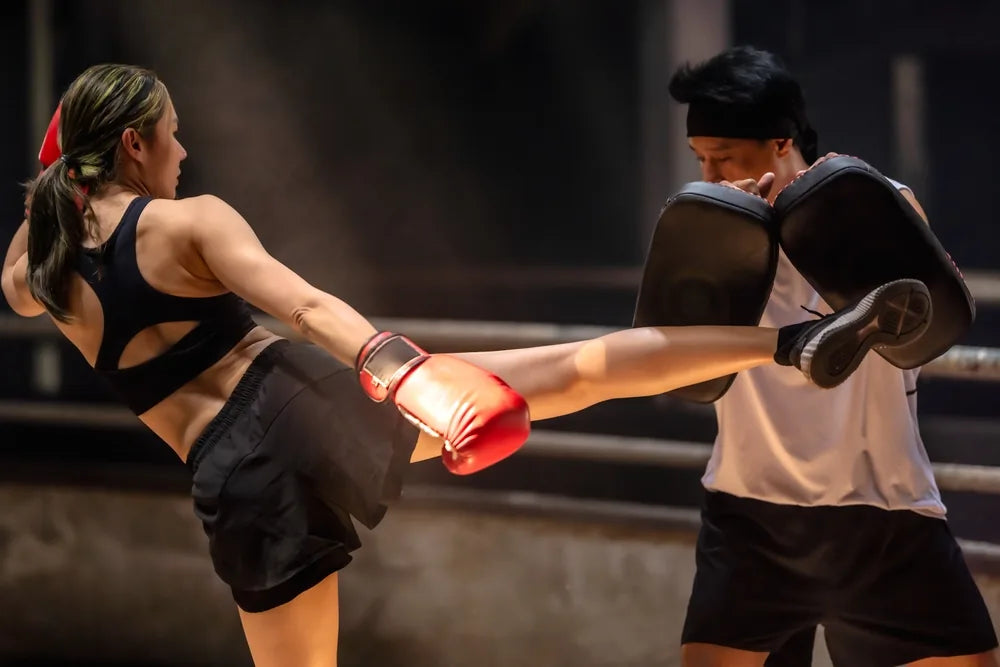
Balanced stance: keep the knees bent and the feet staggered, mirroring a fighter's own guard. Don’t stand flat and square.
-
Weight through the legs: settle into the stance and let the legs take the load, not the arm on its own.
-
Angle off the line: turn the body slightly so the holder is not square-on to the full force of the kick.
-
Stay mobile: reset your feet between strikes so you can feed the next angle instead of rooting to one spot.
A steady base also provides the striker with a fixed target. This enables them to take full-power shots confidently.

What angle should the kick pad be held at?
The angle of the pad changes where the shock of a strike ends up. Be deliberate about it instead of holding the pad however it lands.
-
Around 45 degrees: present the pad at an angle so it gives with the strike rather than stopping it dead.
-
Flat is risky: a pad held flat sends shock straight back into the wrist and forearm.
-
Adjust by strike: angle the pad down and across for a round kick, and hold it flatter and higher to catch a teep or a knee.
By matching the angle to the strike, each kick lands on the padding’s thickest area, protecting the holder and offering the striker more precise feedback.
How do you absorb impact without hurting your arm?
Despite having a firm grip and stable stance, a stiff arm makes every kick feel like a shock. Taking the hit is the final element of secure grip, relying equally on timing and power.
-
Rotate into the strike: turn slightly with the kick rather than holding stiff, sharing the load through the torso.
-
Meet the kick: push gently into the strike at the moment of contact so the pad and the leg meet halfway.
-
Keep the elbow soft: never lock the arm straight at the moment of contact.
-
Manage fatigue: pace the rounds so the holder stays sharp across a full session, instead of bracing hard for a single big shot.
When holders become fatigued, they tend to drop their hands and stiffen, causing knocks, making consistent pacing as crucial as skill.
Why MAVINN kicking pads hold up behind the pads
Good technique only works with a pad that has the build quality to behave the same way every round. A pad that shifts, folds or bottoms out undoes even a well-drilled grip.
MAVINN kicking pads are tested in-house by our coaching team, who use every model in daily classes before it reaches the shop floor. Our pads include a two-strap forearm design, with both straps securing the pad tightly to the arm, enhancing the grip and angle maintained by a holder.
The pads maintain their shape through thousands of hits thanks to layered high-density foam, which prevents dead spots from forming. Alongside double-reinforced stitching, this ensures every load-bearing seam is built for daily use. The pads are available in leather or microfibre outer for suiting different climate and durability needs.
Shop MAVINN kicking pads for safe pad holding
Good Muay Thai pad work and safe holding comes down to three habits: a thumb that never sits under the pad, a pad angled near 45 degrees, and impact absorbed through a soft elbow rather than a locked one. Drill those and the holder stays healthy while the striker gets a target worth hitting.
At MAVINN, we build our Muay Thai kicking pads around the holder as much as the striker, with a two-strap forearm system and layered high-density foam tested by our own coaches through full training weeks. The same pads our team tests in daily classes are the ones that go to our shop.
Browse Muay Thai kicking pads at MAVINN today. Each pair uses double-reinforced stitching and a two-strap forearm system built to protect the holder through daily rounds.
References
- Thai boxing. Retrieved on 22 September 2026 from https://www.britannica.com/sports/Thai-boxing
- International Federation of Muaythai Associations. Retrieved on 22 September 2026 from https://muaythai.sport/
- World Muaythai Council. Retrieved on 22 September 2026 from https://wmcmuaythai.org/
- Epidemiology of Muay Thai fight-related injuries. Retrieved on 22 September 2026 from https://pmc.ncbi.nlm.nih.gov/articles/PMC5149460/
Frequently Asked Questions About Muay Thai Pad Work
How to safely hold kick pads for Muay Thai training?
Start with the grip, keeping all five fingers around the handle and the thumb on top, never underneath. Stand with your knees bent, hold the pad at around 45 degrees, and rotate slightly into each strike so the force runs through your body rather than your wrist. Begin light and build power as the striker warms up.
Why does my thumb hurt after holding pads?
A sore thumb almost always means it was tucked under the pad on impact. Move it on top or to the side so the padding takes the force, and check that both forearm straps are tight enough to stop the pad twisting on contact.
What is the difference between Thai kick pads and focus mitts?
Thai kick pads are larger and built to absorb full-power round kicks, knees and teeps. Focus mitts are smaller and lighter, made for hand speed and combination drills. A complete coaching setup usually includes both.
Can beginners hold kick pads safely?
Yes, and holding pads is one of the quickest ways to learn range and timing. Beginners should work with a confident partner or coach, use correct grip and stance, and build power gradually rather than catching hard strikes straight away.